
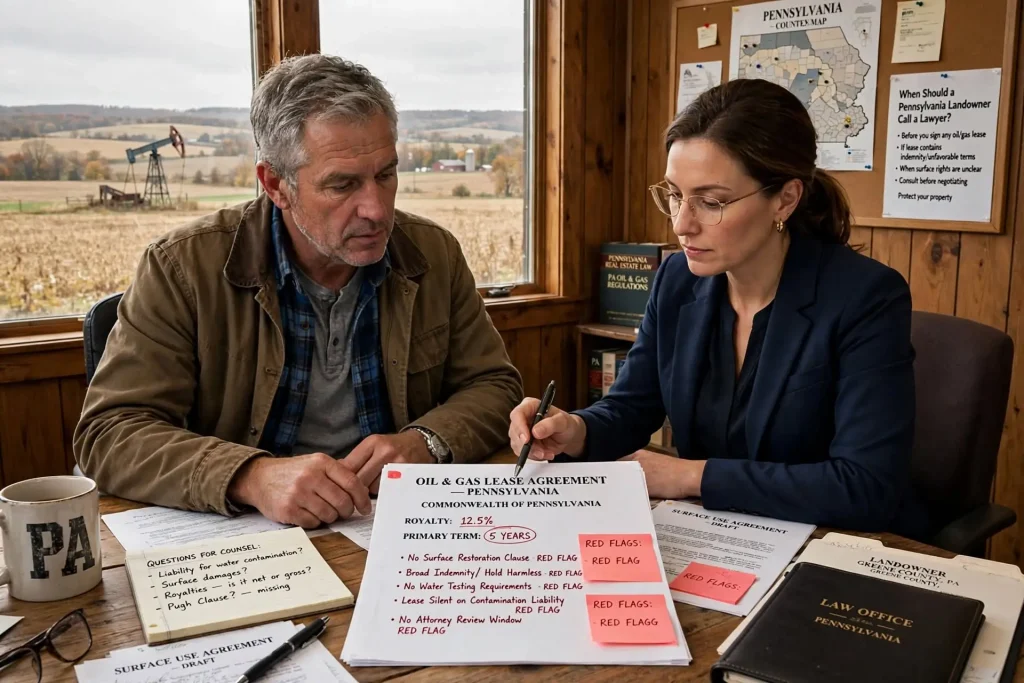
Picture a landowner who had farmed the same ground in Washington County for thirty years when a landman knocked on the door with a lease offer and a pen. The numbers sounded good, the man was friendly, and the paperwork looked official. He almost signed it on the kitchen table that afternoon, before any real oil and gas lease negotiation had taken place.
What stopped him was a single thought that nagged at him all evening: he did not really know what any of the clauses meant. That hesitation is where good negotiation starts, and it is why he ended up with terms he understood instead of terms he regretted.
His instinct was right. The lease an operator hands a landowner is drafted by the operator’s lawyers, for the operator’s benefit. It is a starting point, not a final offer, and the landowner who treats it as something to be reviewed and reworked usually ends up in a better place than the one who signs it as written.
Why Oil & Gas Lease Negotiation Starts With a Second Look
The friendliest part of the whole process is the offer itself. The bonus payment per acre sounds generous, the royalty percentage seems fair, and the landman, who often works for the operator or a leasing company, may not walk through the fine print. That is exactly where the trouble hides. Negotiation is not about distrust. It is about reading what you are signing and knowing which terms can quietly cost you money for years.
His lease had a royalty rate at the low end of what landowners in the area were getting. He only learned that because he asked around before he signed. A neighbor two farms over had negotiated a better rate on a similar lease the year before, and the difference added up to real money over the life of the wells. The operator was not doing anything improper. It offered what it expected a landowner to accept, and many landowners did. For context, Pennsylvania law sets a minimum royalty of one-eighth (12.5%) on gas leases, but that is only a floor, and anything above it is negotiable.
The Clauses That Cause the Most Regret
When he finally sat down with a lawyer, the conversation did not focus on the bonus or even the royalty rate at first. It focused on the clauses most landowners never read. One was the post-production cost language, which allowed the operator to subtract the cost of gathering, compressing, and processing the gas before calculating his royalty. On paper his royalty looked fine. In practice those deductions could shrink his checks by a meaningful share each month. Pennsylvania courts have generally enforced these deductions when the lease language allows them, which is why the exact wording matters.
Another was the term of the lease and how it was renewed. The habendum clause, which sets how long the lease lasts, let the operator hold the lease well beyond the initial period under conditions that were easy to trigger and hard to escape. A Pugh clause can help here by releasing acreage that is not being developed. A third was the surface use language, which said almost nothing about where equipment could go, how roads would be built, or how the land would be restored afterward.
For a working farm, those details were not minor. They decided whether he could keep farming around the operation at all.
How a Lawyer Changes the Shape of the Deal
A lawyer’s value in lease negotiation is knowing which terms are standard, which are negotiable, and which are worth walking away over. It has nothing to do with arguing for the sake of arguing. His lawyer did not try to rewrite the whole lease. The focus was on the handful of terms that mattered most to his income and his land.
They pushed for a royalty free of the heaviest post-production deductions, so that the percentage on paper came closer to the percentage he actually received. They tightened the surface use terms, spelling out where the operator could build and how the ground would be restored when the work was done. They clarified the term so that he was not locked in indefinitely on terms that no longer served him.
None of these changes were dramatic on their own. Together they made the difference between a lease he could live with and one he would have resented for decades.
Knowing the Region Matters
Part of what made the difference was local knowledge. A lawyer who works regularly with landowners in the Marcellus Shale region knows what operators in the area are offering, which terms have become common, and where a landowner has room to push.
This is the kind of experience Kostrub Law Firm, PLLC brings to oil and gas lease negotiation for landowners across Western Pennsylvania. Reviewing leases, explaining what the clauses actually do, and negotiating terms that protect the landowner is regular work for a firm rooted in this part of the state. You can learn more about our oil and gas lease review services.
Lease Red Flags That Mean It Is Time to Make the Call
The hardest part for most landowners is knowing when a lease has crossed from routine into something that needs a professional eye. These are the signs that should make you pause before signing:
- The lease runs for many years, or can be extended past the initial term under conditions you do not fully understand.
- It allows post-production deductions you do not fully follow.
- The surface use terms are vague about where equipment can go, how roads will be built, or how the land will be restored.
- The royalty seems lower than what neighbors have reported.
- You are being pushed to sign quickly, without time to have the lease reviewed.
The cost of a review is small next to the value of a lease that will govern your property for years, sometimes decades.
Looking back, he would say the smartest thing he did was not sign that first afternoon. He did not need to become an expert in oil and gas law. He just needed to recognize that the document in front of him was too important to sign blind. A short conversation with a lawyer gave him terms he understood and the confidence that he had not left money or rights on the table.
If an operator has handed you a lease, the time to look closely is before the ink goes down, not after. A careful review during oil and gas lease negotiation can protect your income and your land for years to come, and it starts with a single phone call. Call Kostrub Law Firm at (304) 982-1586 or send us a message.