
When the well on one family’s land finally started producing, the owner expected the royalty checks to follow within a few months. Instead she got a letter asking her to confirm details about her ownership, and then she got silence. Months passed with no payment and no clear answer about why.
What she did not know yet was that a division order title opinion had turned up a problem with the chain of ownership on her property, and until that problem was cleared, the operator was not going to pay her anything.
Her situation is not unusual. The gas may be flowing, but the money does not move until the operator is confident it knows exactly who owns what. That confidence comes from a title examination, and when the records do not line up cleanly, the payments stall while the ownership gets sorted out.
What a Division Order Title Opinion Has to Do With Your Checks
Before an operator pays royalties, it needs to know how to divide them. A division order title opinion, which is usually ordered by the operator’s attorneys rather than the landowner, is the examination that answers that question by tracing the ownership of the minerals back through the records. It tells the operator who owns what fraction of the production, and the operator uses it to build the division order, the document that sets each owner’s share.
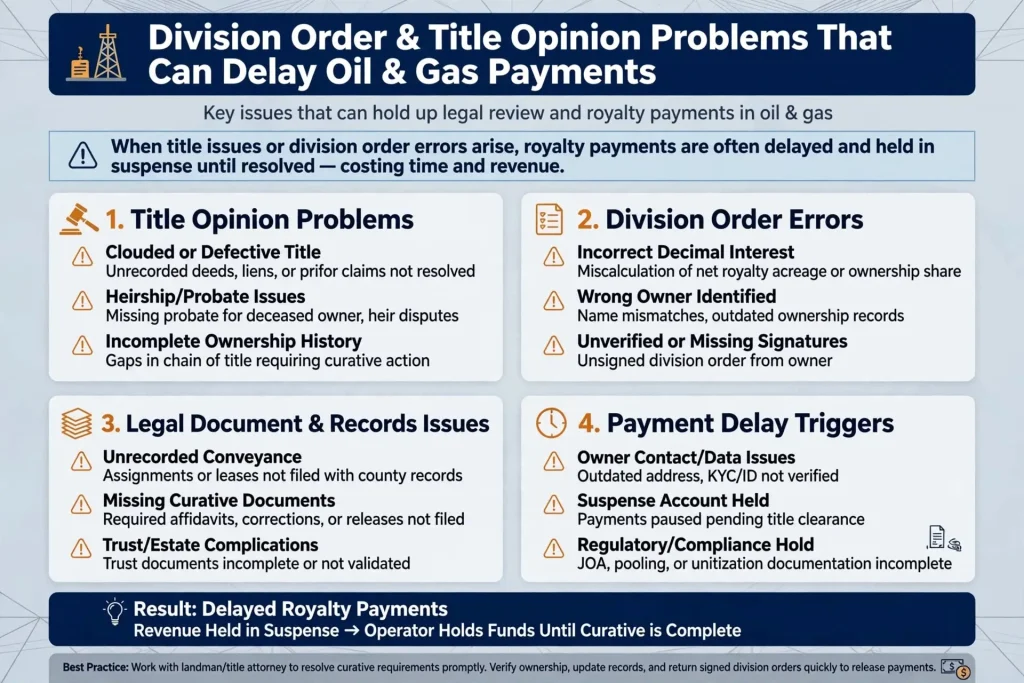
When the title is clean, this step moves quickly and the checks start flowing. When the title has gaps, errors, or unanswered questions, the operator holds the payments rather than risk paying the wrong person. From the operator’s point of view this is simple caution. From the landowner’s point of view it feels like being punished for a problem they did not know existed.
Pennsylvania law gives operators some room to do this, but not unlimited room. Under the state’s Oil and Gas Lease Act, unconventional operators must generally make the first royalty payment within 120 days of the first sale, and then within 60 days after the end of each month in which production is sold. Late payments accrue interest, and payments may be suspended only in limited situations, including when the owner lacks marketable title or when there is a genuine dispute about the interest. A title defect is exactly the kind of problem that can trigger that exception.
The Problems That Show Up Most Often
In her case, the trouble traced back two generations. Her grandfather had passed the land to her father, but the transfer of the mineral rights had never been recorded properly. On paper, part of the ownership still appeared to sit with her grandfather and others who had died decades earlier. Until that gap was closed, the operator could not be sure she owned the full share she claimed.
Problems like this take many forms. Sometimes an estate was never fully probated, so the records never showed the minerals passing to the heirs. Sometimes a deed from years ago contained an error in the legal description that clouds the title today. Sometimes the minerals were divided among several heirs over the years, and no one ever tracked exactly who ended up with what. Each of these can surface in a division order title opinion and freeze the payments until it is resolved.
There are also cases where two records seem to describe the same interest in ways that do not match, leaving the operator unsure which one to trust. In every version of the problem, the operator reaches the same conclusion, which is that it cannot pay with confidence until the ownership is settled on paper. That caution is why a defect that might look small to a landowner can hold up a check for months.
How These Delays Get Resolved
The good news was that the problem was fixable. The harder news was that fixing it took the right legal work, done in the right order, with the county records to back it up. Clearing a title defect is not about arguing. It is about assembling the proof that shows who actually owns the minerals and recording the documents that make that ownership clear on paper.
For her that meant working through the family’s estate records, confirming how the minerals had passed from her grandfather to her father to her, and recording the documents that closed the gap in the chain. Depending on the facts, that can include opening or completing an estate through the Register of Wills, recording an affidavit of heirship, or preparing a corrective deed. Once the title was clear, the operator updated the division order and released the payments that had been building up the whole time. The money had been waiting. It just needed the ownership resolved before it could move. Whether interest is owed on funds held during that time depends on the lease and the circumstances, so it is worth asking.
Where Experience Makes the Difference
Resolving a title problem tied to a division order title opinion takes someone who can read the chain of title, spot exactly where it breaks, and know how to close the gap under Pennsylvania law. This is the kind of work Kostrub Law Firm, PLLC handles for landowners across the region, pairing careful title opinion work with the practical steps needed to clear a defect and get the payments moving.
For a firm with deep roots in oil and gas title work, tracing ownership and curing a flawed title is familiar ground, and that familiarity often turns a frustrating delay into a solved problem.
Getting Ahead of the Problem
Her experience holds a lesson for any landowner who expects royalty income someday. Title problems do not announce themselves until the money is on the line, and by then the delay is already underway. The landowners who move through this most smoothly are often the ones who had their ownership reviewed before production ever started, so that any defect was found and fixed while there was no pressure and no stalled checks waiting on the outcome.
If your family has held mineral rights for a generation or more, it is not unusual to find a gap somewhere in the chain. Estates that were handled informally, deeds with old errors, and ownership divided among heirs over the years all leave marks on the title that a division order title opinion will eventually find. Looking into it early turns a future emergency into a routine fix.
She got her checks in the end, and the back payments made the wait worthwhile. What would frustrate most landowners in her position, though, is how long she spent in the dark, not knowing why the money was not coming. A title problem is far easier to handle when you understand what it is and have someone who knows how to clear it.
If your royalty payments have stalled, or if you simply want to know your ownership is clean before production begins, having a lawyer examine the title is the step that gets the money moving and keeps it moving. Call Kostrub Law Firm at (304) 982-1586 or send us a message.